Balance the budget; curtail spending; reduce debt - three aspects of simple fiscal management. At one time or another, nearly every American has done these things to keep their financial house in order. Now it's the government's turn. Trouble is, the powers that be haven't agreed on how to do it. Meanwhile, all the posturing in Washington is fueling investor frustrations as experts warn that failing to raise the debt ceiling will have disastrous consequences. Why is this such a complicated issue? And perhaps more importantly, why does immediate action need to be taken?
Click this link to read the whitepaper
SPECIAL EDITION ON DEBT CEILING
Wednesday, July 20, 2011

Monday, April 18, 2011
Spring
April 7, 2011
Dear Valued Investor:
The transition from March to April generally marks the turning point in the seasonal calendar from winter to spring. For many Americans, this transition also marks the end of pothole season and the beginning of mud season. While the daily commute might inflict less damage on their cars, it will not always be a clean ride in the coming weeks and months. As I reflect on the performance of the stock market in the first quarter, I see a market that dodged many potholes to deliver another quarterly gain for investors. Though stocks enjoyed their best first quarter in nearly fifteen years, the strong performance may leave less fuel for gains between now and the end of the year as investors try not to get dragged down in the mud.
The stock market, as measured by the S&P 500 Index, gained 5.9% in the first quarter of 2011 and marked the best first-quarter gain since 1998. It was not a smooth ride higher as the index gained 7% in the first six weeks of the year, gave up all of those gains between mid-February and mid-March, then moved higher in eight of the last eleven trading sessions to finish out the quarter. Throughout the quarter, potholes aplenty attempted to impede the market’s move higher: crippling snowstorms that buried most of the country in January, a potential U.S. government shutdown, state and municipal budget battles, ongoing European debt issues, oil prices above $100 per barrel and gasoline prices that approached $4, violence and political uncertainty in North Africa and the Middle East, and the earthquake, tsunami, and nuclear accident in Japan.
Despite the potential for one or more potholes to create a flat tire, another strong earnings season and an improving economy kept the car on the road through the first quarter. More than 72% of S&P 500 companies reported better-than-expected earnings in the fourth quarter of 2010 and more than 62% of companies exceeded revenue forecasts. Looking at the upcoming first quarter 2011 earnings season, a resilient global economy, strong manufacturing data, a quiet pre-announcement earnings season, and continued positive revisions to earnings estimates all bode well for investors. Consumer spending remained solid in the first quarter despite elevated levels of unemployment. Yet, I am encouraged by recent trends on the jobs front, as the U.S. government employment report for March showed nonfarm payrolls gained 216,000, the biggest number yet for this recovery, and the unemployment rate fell 0.1% to 8.8%. Additionally, the number of temporary workers in the workforce, one of the best leading indicators for future job gains, increased in March as did hours worked, while overtime hours remained steady. These metrics indicate to me that companies are probably running at or near peak capacity and need to hire new employees in order to expand production.
The market’s resiliency in the first quarter is encouraging, and I think the market can move higher from here. Given our expectations for mid-to-high single-digit returns this year, however, the stock market likely does not have enough gas left in the tank to deliver gains similar to those witnessed in the first quarter. I do not think the market will run out of fuel, but it is likely to be a slower ride as the market does its best to navigate the road, and mud puddles, ahead.
As always, I encourage you to contact me if you have any questions.
Robert Russo, AAMS, CRPS
BLACKBRIDGE FINANCIAL
Managing Partner
12610 N. Community House Rd, Suite 204
Charlotte, North Carolina 28277
-------------------
Phone: 704.499.3387
Fax: 704.731.0193
rrusso@bbridgefin.com
www.blackbridgefinancial.com
Securities offered through LPL Financial Member FINRA/SIPC
The opinions voiced in this material are for general information only and are not intended to provide specific advice or recommendations for any individual. To determine which investment(s) may be appropriate for you, consult your financial advisor prior to investing. All performance referenced is historical and is no guarantee of future results. All indices are unmanaged and cannot be invested into directly.
The Standard & Poor’s 500 Index is a capitalization-weighted index of 500 stocks designed to measure performance of the broad domestic economy through changes in the aggregate market value of 500 stocks representing all major industries.
Stock investing may involve risk including loss of principal.
Past performance is no guarantee of future results.
This research material has been prepared by LPL Financial.
The LPL Financial family of affiliated companies includes LPL Financial and UVEST Financial Services Group, Inc., each of which is a member of FINRA/SIPC.
To the extent you are receiving investment advice from a separately registered independent investment advisor, please note that LPL Financial is not an affiliate of and make no representation with respect to such entity.
Not FDIC or NCUA/NCUSIF Insured
No Bank or Credit Union Guarantee
May Lose Value
Not Guaranteed by any Government Agency
Not a Bank/Credit Union Deposit Member FINRA/SIPC
Tracking #718427
(Exp.04/12)
Dear Valued Investor:
The transition from March to April generally marks the turning point in the seasonal calendar from winter to spring. For many Americans, this transition also marks the end of pothole season and the beginning of mud season. While the daily commute might inflict less damage on their cars, it will not always be a clean ride in the coming weeks and months. As I reflect on the performance of the stock market in the first quarter, I see a market that dodged many potholes to deliver another quarterly gain for investors. Though stocks enjoyed their best first quarter in nearly fifteen years, the strong performance may leave less fuel for gains between now and the end of the year as investors try not to get dragged down in the mud.
The stock market, as measured by the S&P 500 Index, gained 5.9% in the first quarter of 2011 and marked the best first-quarter gain since 1998. It was not a smooth ride higher as the index gained 7% in the first six weeks of the year, gave up all of those gains between mid-February and mid-March, then moved higher in eight of the last eleven trading sessions to finish out the quarter. Throughout the quarter, potholes aplenty attempted to impede the market’s move higher: crippling snowstorms that buried most of the country in January, a potential U.S. government shutdown, state and municipal budget battles, ongoing European debt issues, oil prices above $100 per barrel and gasoline prices that approached $4, violence and political uncertainty in North Africa and the Middle East, and the earthquake, tsunami, and nuclear accident in Japan.
Despite the potential for one or more potholes to create a flat tire, another strong earnings season and an improving economy kept the car on the road through the first quarter. More than 72% of S&P 500 companies reported better-than-expected earnings in the fourth quarter of 2010 and more than 62% of companies exceeded revenue forecasts. Looking at the upcoming first quarter 2011 earnings season, a resilient global economy, strong manufacturing data, a quiet pre-announcement earnings season, and continued positive revisions to earnings estimates all bode well for investors. Consumer spending remained solid in the first quarter despite elevated levels of unemployment. Yet, I am encouraged by recent trends on the jobs front, as the U.S. government employment report for March showed nonfarm payrolls gained 216,000, the biggest number yet for this recovery, and the unemployment rate fell 0.1% to 8.8%. Additionally, the number of temporary workers in the workforce, one of the best leading indicators for future job gains, increased in March as did hours worked, while overtime hours remained steady. These metrics indicate to me that companies are probably running at or near peak capacity and need to hire new employees in order to expand production.
The market’s resiliency in the first quarter is encouraging, and I think the market can move higher from here. Given our expectations for mid-to-high single-digit returns this year, however, the stock market likely does not have enough gas left in the tank to deliver gains similar to those witnessed in the first quarter. I do not think the market will run out of fuel, but it is likely to be a slower ride as the market does its best to navigate the road, and mud puddles, ahead.
As always, I encourage you to contact me if you have any questions.
Robert Russo, AAMS, CRPS
BLACKBRIDGE FINANCIAL
Managing Partner
12610 N. Community House Rd, Suite 204
Charlotte, North Carolina 28277
-------------------
Phone: 704.499.3387
Fax: 704.731.0193
rrusso@bbridgefin.com
www.blackbridgefinancial.com
Securities offered through LPL Financial Member FINRA/SIPC
The opinions voiced in this material are for general information only and are not intended to provide specific advice or recommendations for any individual. To determine which investment(s) may be appropriate for you, consult your financial advisor prior to investing. All performance referenced is historical and is no guarantee of future results. All indices are unmanaged and cannot be invested into directly.
The Standard & Poor’s 500 Index is a capitalization-weighted index of 500 stocks designed to measure performance of the broad domestic economy through changes in the aggregate market value of 500 stocks representing all major industries.
Stock investing may involve risk including loss of principal.
Past performance is no guarantee of future results.
This research material has been prepared by LPL Financial.
The LPL Financial family of affiliated companies includes LPL Financial and UVEST Financial Services Group, Inc., each of which is a member of FINRA/SIPC.
To the extent you are receiving investment advice from a separately registered independent investment advisor, please note that LPL Financial is not an affiliate of and make no representation with respect to such entity.
Not FDIC or NCUA/NCUSIF Insured
No Bank or Credit Union Guarantee
May Lose Value
Not Guaranteed by any Government Agency
Not a Bank/Credit Union Deposit Member FINRA/SIPC
Tracking #718427
(Exp.04/12)
Tuesday, March 1, 2011
Oil and Gas on Higher Ground
As turmoil in the Middle East continues to roil the markets, it is no coincidence that "oil" is at the root of economic concerns. From an investment perspective, analyzing oil's relationship to the markets is crucial, but the reality is that nearly everyone (investors and non-investors alike) are affected by oil prices. So what exactly is affecting the rise in oil costs? And, more importantly, do oil prices have the potential to derail America's economic recovery?
After the fall of dictatorial governments in Tunisia and Egypt, unrest has spread throughout the Middle East, with Libya dominating the spotlight this week. The International Energy Agency reported late Friday that Libya is probably producing about 850,000 barrels of oil daily, down from its normal capacity of 1.6 million barrels, which represents just under 2% of the world's oil supply. While the sudden oil shortage hits European refiners the hardest,[1] oil fears still caused the stock market to suffer its first weekly loss in a month. For the week, the S&P 500 slid 1.7%; the Dow dropped 2.1%, and the Nasdaq fell 1.9%.[2] Happily, fears were eased somewhat on Friday when Saudi Arabia reported it has increased its crude oil production to 9 million barrels a day to make up for supplies lost in Libya.[3]
What we're seeing right now is a tug of war between worry and economic fundamentals. While most U.S. economic data looks good, investors are focused on the potential implications of interruptions in oil production. For the moment, this issue will dominate the headlines regardless of how attractive other data looks.
U.S. drivers have already been feeling the pinch at the pump, with gas prices spiking 6 cents on Friday, the biggest one-day jump in two years. The national average price for a gallon of regular gas rose to $3.29, according to AAA, marking the fourth day in a row that prices have risen and bringing the national average to the highest level since October 2008. In general, every $1 increase in the price of oil costs consumers $1 billion over the course of a year.[4] Higher oil prices also weigh on the U.S. economy by increasing the costs of moving goods,[5] thus transferring rising costs to manufacturers, wholesalers, retailers, and eventually the American public.
If gas prices continue to rise as some analysts predict, how will this affect the economic recovery? Put simply, there is no way to know for sure. Granted, when gas prices go up, Americans have less to spend on everything else. And since consumer spending makes up over 70% of the U.S. economy[6], a drop in spending could slow the recovery down. At the same time though, modest increases in fuel prices do not inevitably cause economic slowdowns. What they more often do is cause alarm, thus affecting consumers' perceptions about what they can afford and causing them to react by tightening their belts.
So while the natural reaction may be to retreat to conservative investments and cut-off all spending on nonessentials, it is important to avoid overreacting. The coming week promises to shed more light on the true status of our domestic economy as various data related to jobs, payrolls, and manufacturing are released.[7]
ECONOMIC CALENDAR:
Monday - Personal Income and Outlays, Chicago PMI, Pending Home Sales
Tuesday - Redbook, Construction Spending
Wednesday - ADP Employment Report, EIA Petroleum Status Report, Beige Book
Thursday - ECB Announcement, Jobless Claims, Productivity and Costs, ISM Non-Mfg Index Friday - Employment Situation, Factory Orders
As turmoil in the Middle East continues to roil the markets, it is no coincidence that "oil" is at the root of economic concerns. From an investment perspective, analyzing oil's relationship to the markets is crucial, but the reality is that nearly everyone (investors and non-investors alike) are affected by oil prices. So what exactly is affecting the rise in oil costs? And, more importantly, do oil prices have the potential to derail America's economic recovery?
After the fall of dictatorial governments in Tunisia and Egypt, unrest has spread throughout the Middle East, with Libya dominating the spotlight this week. The International Energy Agency reported late Friday that Libya is probably producing about 850,000 barrels of oil daily, down from its normal capacity of 1.6 million barrels, which represents just under 2% of the world's oil supply. While the sudden oil shortage hits European refiners the hardest,[1] oil fears still caused the stock market to suffer its first weekly loss in a month. For the week, the S&P 500 slid 1.7%; the Dow dropped 2.1%, and the Nasdaq fell 1.9%.[2] Happily, fears were eased somewhat on Friday when Saudi Arabia reported it has increased its crude oil production to 9 million barrels a day to make up for supplies lost in Libya.[3]
What we're seeing right now is a tug of war between worry and economic fundamentals. While most U.S. economic data looks good, investors are focused on the potential implications of interruptions in oil production. For the moment, this issue will dominate the headlines regardless of how attractive other data looks.
U.S. drivers have already been feeling the pinch at the pump, with gas prices spiking 6 cents on Friday, the biggest one-day jump in two years. The national average price for a gallon of regular gas rose to $3.29, according to AAA, marking the fourth day in a row that prices have risen and bringing the national average to the highest level since October 2008. In general, every $1 increase in the price of oil costs consumers $1 billion over the course of a year.[4] Higher oil prices also weigh on the U.S. economy by increasing the costs of moving goods,[5] thus transferring rising costs to manufacturers, wholesalers, retailers, and eventually the American public.
If gas prices continue to rise as some analysts predict, how will this affect the economic recovery? Put simply, there is no way to know for sure. Granted, when gas prices go up, Americans have less to spend on everything else. And since consumer spending makes up over 70% of the U.S. economy[6], a drop in spending could slow the recovery down. At the same time though, modest increases in fuel prices do not inevitably cause economic slowdowns. What they more often do is cause alarm, thus affecting consumers' perceptions about what they can afford and causing them to react by tightening their belts.
So while the natural reaction may be to retreat to conservative investments and cut-off all spending on nonessentials, it is important to avoid overreacting. The coming week promises to shed more light on the true status of our domestic economy as various data related to jobs, payrolls, and manufacturing are released.[7]
ECONOMIC CALENDAR:
Monday - Personal Income and Outlays, Chicago PMI, Pending Home Sales
Tuesday - Redbook, Construction Spending
Wednesday - ADP Employment Report, EIA Petroleum Status Report, Beige Book
Thursday - ECB Announcement, Jobless Claims, Productivity and Costs, ISM Non-Mfg Index Friday - Employment Situation, Factory Orders
Tuesday, February 15, 2011
The Markets:
Wall Street started last week holding its breath while waiting to see whether Hosni Mubarak would step down as Egypt's president. Bowing to pro-democracy protests, Mubarak resigned on Friday, ending 30 years of authoritarian rule in the Middle East's most populous country.[1]
As fireworks burst over Cairo's Tahrir Square, there was a collective sigh of relief on Wall Street, while the benchmark averages rose to finish Friday's session with weekly gains. U.S. stocks climbed to fresh 2 1/2-year closing highs after the resignation of Mubarak removed a layer of uncertainty from global markets.[2] The Dow had a weekly advance of 1.5%, while the S&P 500 rose 1.4% and the Nasdaq added 1.5%.
Most analysts and investors agree that Mubarak's resignation dramatically reduces geopolitical risk and uncertainty from the region.[3] Reflecting this, oil prices fell following the news in Egypt, with crude dropping to $85.16 a barrel in midday trading Friday. Other dollar-denominated commodities, including gold and silver, also drifted lower following Mubarak's resignation. Gold prices slid $5.30, settling at $1,357.20 an ounce.[4]
On another topic, how does starting a new week on St. Valentine's Day traditionally affect the markets? Interestingly, the "day of love" hasn't customarily shown much "love" to investors; at least when using the S&P 500 index as a gauge. According to Howard Silverblatt, a senior index analyst at S&P Indices, going back to 1928, February 14 trading days only notched gains on the S&P 38.7% of the time against a historical daily rate of 52.03%. Here's an interesting caveat though - in looking at the 11 Valentine's Days that occurred on the first trading day of the week, the S&P 500 logged a gain 63.4% of the time.[5] While we're certainly not trying to make a prediction, it is interesting to see what history can teach us about market behaviors.
From war and peace one week, to love and chocolates the next, it just goes to show that almost any world event has potential to affect people's investments. Like everything in life, weathering all the little ups and downs requires intelligence, patience, and a cool head.
ECONOMIC CALENDAR:
Tuesday - Retail Sales, Empire State Mfg. Survey, Import and Export Prices, Redbook, Treasury International Capital, Business Inventories, Housing Market Index
Wednesday - Housing Starts, Producer Price Index, Industrial Production, EIA Petroleum Status Report, FOMC Minutes
Thursday - Consumer Price Index, Jobless Claims, Industrial Production, Leading
Performance
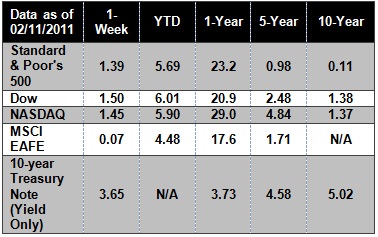
Notes: All index returns exclude reinvested dividends, and the 5-year and 10-year returns are annualized.
Sources: Yahoo! Finance, MSCI Barra. Past performance is no guarantee of future results.
Indices are unmanaged and cannot be invested into directly. NA means not available.
Wall Street started last week holding its breath while waiting to see whether Hosni Mubarak would step down as Egypt's president. Bowing to pro-democracy protests, Mubarak resigned on Friday, ending 30 years of authoritarian rule in the Middle East's most populous country.[1]
As fireworks burst over Cairo's Tahrir Square, there was a collective sigh of relief on Wall Street, while the benchmark averages rose to finish Friday's session with weekly gains. U.S. stocks climbed to fresh 2 1/2-year closing highs after the resignation of Mubarak removed a layer of uncertainty from global markets.[2] The Dow had a weekly advance of 1.5%, while the S&P 500 rose 1.4% and the Nasdaq added 1.5%.
Most analysts and investors agree that Mubarak's resignation dramatically reduces geopolitical risk and uncertainty from the region.[3] Reflecting this, oil prices fell following the news in Egypt, with crude dropping to $85.16 a barrel in midday trading Friday. Other dollar-denominated commodities, including gold and silver, also drifted lower following Mubarak's resignation. Gold prices slid $5.30, settling at $1,357.20 an ounce.[4]
On another topic, how does starting a new week on St. Valentine's Day traditionally affect the markets? Interestingly, the "day of love" hasn't customarily shown much "love" to investors; at least when using the S&P 500 index as a gauge. According to Howard Silverblatt, a senior index analyst at S&P Indices, going back to 1928, February 14 trading days only notched gains on the S&P 38.7% of the time against a historical daily rate of 52.03%. Here's an interesting caveat though - in looking at the 11 Valentine's Days that occurred on the first trading day of the week, the S&P 500 logged a gain 63.4% of the time.[5] While we're certainly not trying to make a prediction, it is interesting to see what history can teach us about market behaviors.
From war and peace one week, to love and chocolates the next, it just goes to show that almost any world event has potential to affect people's investments. Like everything in life, weathering all the little ups and downs requires intelligence, patience, and a cool head.
ECONOMIC CALENDAR:
Tuesday - Retail Sales, Empire State Mfg. Survey, Import and Export Prices, Redbook, Treasury International Capital, Business Inventories, Housing Market Index
Wednesday - Housing Starts, Producer Price Index, Industrial Production, EIA Petroleum Status Report, FOMC Minutes
Thursday - Consumer Price Index, Jobless Claims, Industrial Production, Leading
Performance
Notes: All index returns exclude reinvested dividends, and the 5-year and 10-year returns are annualized.
Sources: Yahoo! Finance, MSCI Barra. Past performance is no guarantee of future results.
Indices are unmanaged and cannot be invested into directly. NA means not available.
Tuesday, February 8, 2011
Newsletter
Weekly Market Update
Week of February 7, 2011
The Markets:
In spite of ongoing turmoil in Egypt and the Middle East, the markets continued their gain last week. For the period ending February 4th, the Dow rose 2.3%, the S&P 500 gained 2.7%, and the Nasdaq climbed 3.1%[1] reflecting elevated optimism in the markets. The AAII Sentiment Survey for last week shows that 51.5% of investors are feeling bullish, up 9.5% from the week of January 24th. That's well above the historical average of 39%.[2]
Indeed, this optimism is even more remarkable in light of last week's jobs report which has been subject to conflicting opinions and interpretations. Case in point: According to a MarketWatch headline from Friday, the "job crisis isn't over",[3] while a cnnmoney.com headline from the same day touted that, "the job market is getting better."[4] Each headline could be considered accurate, but clearly they offer different slants. Though the rate of hiring did not show a notable increase, the unemployment rate still fell to 9.0%[5] - bad news and good news at the same time. Some analysts predict that bad weather across the U.S. is partially to blame, with more than 850,000 workers prevented from working at the time the survey was conducted.[6] Other explanations have also been cited, and as a result, it appears that many are waiting for February's report for clarification before jumping to conclusions.
Recent events, both within the U.S. and internationally, illustrate a noteworthy aspect of investing: It is impossible to predict how the stock market will react to news. Such an optimistic week in light of Egyptian strife and a conflicting jobs report is a pleasant surprise. It seems that the market has had time to price in geopolitical risks in Egypt and sluggish jobs growth and found such factors to be no immediate threat.[7] Clearly, the headlines and the stock market do not always move in tandem. This is a good fact to remember when evaluating how much credence should be given to sensational news reports.
ECONOMIC CALENDAR
Tuesday - Redbook
Wednesday - Bank Reserve Settlement, EIA Petroleum Status
Thursday - BOE Announcement, Jobless Claims, Wholesale Trades, Treasury Budget
Friday - International Trade, Consumer Sentiment
Performance
Notes: All index returns exclude reinvested dividends, and the 5-year and 10-year returns are annualized.
Sources: Yahoo! Finance, MSCI Barra. Past performance is no guarantee of future results.
Indices are unmanaged and cannot be invested into directly. NA means not available.
Headlines:
The Green Bay Packers won their fourth Superbowl title in a 31-25 victory over the Pittsburgh Steelers. The Vince Lombardi Trophy is headed back to Titletown for the first time in 14 years.[8]
Super Bowl-related consumer spending will reach $10.1 billion this year, the National Retail Federation says. The Washington-based trade group cites a survey conducted by its Retail Advertising and Marketing Association division that says the average consumer will spend $59.33 on game-related merchandise, apparel and snacks, up from $52.63 last year.[9]
Hackers have repeatedly penetrated the computers running Nasdaq during the past year. Though the exchange's trading platform was not violated and no information has been compromised, a federal investigation is underway.[10]
Businesses' unemployment-insurance payments rose 37% in 2010. Last year, the amount employers paid into state unemployment-insurance funds rose 34%. Combined with the increase in total wages, businesses paid out $43 billion.[11]
On Friday, Bank of America appointed a new foreclosure and loan modifications czar, and created a new unit to oversee problem home loans. The new unit creates a seventh major division at the bank and will be overseen by Terry Laughlin. The move splits the largest U.S. bank by assets' mortgage business: one focused on new and current mortgages, and another dedicated to foreclosures.[12]
"A pessimist sees the difficulty in every opportunity;
an optimist sees the opportunity in every difficulty." - Winston Churchill
Roasted Pepper and Artichoke Pizza
From: Diabetic Living
Artichoke hearts and goat cheese make this chicken pizza good for entertaining. It's meant to be a main dish but it could also be a party appetizer.
Servings: 8 servings
Prep: 15 mins
Total: 35 mins
Ingredients:
1 6- to 6-1/2-ounce package pizza crust mix
1 teaspoon dried oregano or basil, crushed
1/2 cup pizza sauce
1 cup coarsely chopped or shredded cooked chicken (about 5 ounces)
1 6-ounce jar marinated artichoke hearts, drained and coarsely chopped
1 cup roasted red and/or yellow sweet peppers, cut into strips
1/4 cup sliced green onions or chopped red onion
1/2 cup shredded part-skim mozzarella cheese (2 ounces)
4 ounces semisoft goat cheese (chevre), crumbled
Directions:
1. Preheat oven to 425 degrees F. Grease a large baking sheet; set aside. Prepare pizza crust according to package directions, except stir oregano into dry mix. With floured hands, pat dough into a 15x10-inch rectangle on prepared baking sheet, building up edges slightly (crust will be thin). Bake for 7 minutes.
2. Spread pizza sauce evenly over crust. Top with chicken, artichokes, roasted peppers, and green onion. Top with mozzarella cheese and goat cheese.
3. Bake for 13 to 15 minutes more or until edges of crust are golden brown. Makes 8 servings.
Wrist Action
Be careful not to flex the wrists when chipping and putting. Golfers usually do not even realize they are flexing their wrists during these shots. When this happens, controlling distance becomes almost impossible, loft will be incorrect at impact, and putts lose true roll and consistent distance control.
Always keep your wrist solid and avoid flexing them for putts or chip shots. This is imperative to achieve consistency.
Share the Wealth of Knowledge!
Please share this market update with family, friends, or colleagues. If you would like us to add them to our list, simply click on the "Forward email" link below. We love being introduced!
Investing involves risk including the potential loss of principal. No investment strategy can guarantee a profit or protect against loss in periods of declining values.
The Standard & Poor's 500 (S&P 500) is an unmanaged group of securities considered to be representative of the stock market in general.
The Dow Jones Industrial Average is a price-weighted average of 30 significant stocks traded on the New York Stock Exchange and the Nasdaq. The DJIA was invented by Charles Dow back in 1896.
The MSCI EAFE Index was created by Morgan Stanley Capital International (MSCI) that serves as a benchmark of the performance in major international equity markets as represented by 21 major MSCI indexes from Europe, Australia and Southeast Asia.
The 10-year Treasury Note represents debt owed by the United States Treasury to the public. Since the U.S. Government is seen as a risk-free borrower, investors use the 10-year Treasury Note as a benchmark for the long-term bond market.
Google Finance is the source for any reference to the performance of an index between two specific periods.
Opinions expressed are subject to change without notice and are not intended as investment advice or to predict future performance.
Past performance does not guarantee future results.
You cannot invest directly in an index.
Consult your financial professional before making any investment decision.
Fixed income investments are subject to various risks including changes in interest rates, credit quality, inflation risk, market valuations, prepayments, corporate events, tax ramifications and other factors.
These are the views of Platinum Advisor Marketing Strategies, LLC, and not necessarily those of the named representative or named Broker dealer, and should not be construed as investment advice. Neither the named representative nor the named Broker dealer gives tax or legal advice. All information is believed to be from reliable sources; however, we make no representation as to its completeness or accuracy. Please consult your financial advisor for further information.
[1] www.marketwatch.com/story/us-stocks-rise-extending-weekly-gains-to-2-2011-02-04?dist=afterbell
[2] www.aaii.com/SentimentSurvey
[3] http://www.marketwatch.com/story/only-thing-we-know-is-job-crisis-isnt-over-2011-02-04?dist=afterbell
[4] http://money.cnn.com/2011/02/04/news/economy/unemployment_decline_mystery/index.htm
[5] www.money.cnn.com/2011/02/04/news/economy/unemployment_decline_mystery/index.htm
[6] www.marketwatch.com/story/only-thing-we-know-is-job-crisis-isnt-over-2011-02-04?dist=afterbell
[7] www.money.cnn.com/2011/02/04/markets/markets_newyork/index.htm
[8] http://nbcsports.msnbc.com/id/41450378/ns/sports-super_bowl_xlv/
[9] http://www.bizjournals.com/denver/news/2011/02/06/super-bowl-consumer-spending-to-top-10b.html
[10] www.online.wsj.com/article/SB10001424052748704709304576124502351634690.html?mod=WSJ_hp_LEFTWhatsNewsCollection
[11] www.blogs.wsj.com/economics/2011/02/05/number-of-the-week-businesses-unemployment-taxes-rise/
[12] www.cnbc.com/id/41430991
Week of February 7, 2011
The Markets:
In spite of ongoing turmoil in Egypt and the Middle East, the markets continued their gain last week. For the period ending February 4th, the Dow rose 2.3%, the S&P 500 gained 2.7%, and the Nasdaq climbed 3.1%[1] reflecting elevated optimism in the markets. The AAII Sentiment Survey for last week shows that 51.5% of investors are feeling bullish, up 9.5% from the week of January 24th. That's well above the historical average of 39%.[2]
Indeed, this optimism is even more remarkable in light of last week's jobs report which has been subject to conflicting opinions and interpretations. Case in point: According to a MarketWatch headline from Friday, the "job crisis isn't over",[3] while a cnnmoney.com headline from the same day touted that, "the job market is getting better."[4] Each headline could be considered accurate, but clearly they offer different slants. Though the rate of hiring did not show a notable increase, the unemployment rate still fell to 9.0%[5] - bad news and good news at the same time. Some analysts predict that bad weather across the U.S. is partially to blame, with more than 850,000 workers prevented from working at the time the survey was conducted.[6] Other explanations have also been cited, and as a result, it appears that many are waiting for February's report for clarification before jumping to conclusions.
Recent events, both within the U.S. and internationally, illustrate a noteworthy aspect of investing: It is impossible to predict how the stock market will react to news. Such an optimistic week in light of Egyptian strife and a conflicting jobs report is a pleasant surprise. It seems that the market has had time to price in geopolitical risks in Egypt and sluggish jobs growth and found such factors to be no immediate threat.[7] Clearly, the headlines and the stock market do not always move in tandem. This is a good fact to remember when evaluating how much credence should be given to sensational news reports.
ECONOMIC CALENDAR
Tuesday - Redbook
Wednesday - Bank Reserve Settlement, EIA Petroleum Status
Thursday - BOE Announcement, Jobless Claims, Wholesale Trades, Treasury Budget
Friday - International Trade, Consumer Sentiment
Performance
Notes: All index returns exclude reinvested dividends, and the 5-year and 10-year returns are annualized.
Sources: Yahoo! Finance, MSCI Barra. Past performance is no guarantee of future results.
Indices are unmanaged and cannot be invested into directly. NA means not available.
Headlines:
The Green Bay Packers won their fourth Superbowl title in a 31-25 victory over the Pittsburgh Steelers. The Vince Lombardi Trophy is headed back to Titletown for the first time in 14 years.[8]
Super Bowl-related consumer spending will reach $10.1 billion this year, the National Retail Federation says. The Washington-based trade group cites a survey conducted by its Retail Advertising and Marketing Association division that says the average consumer will spend $59.33 on game-related merchandise, apparel and snacks, up from $52.63 last year.[9]
Hackers have repeatedly penetrated the computers running Nasdaq during the past year. Though the exchange's trading platform was not violated and no information has been compromised, a federal investigation is underway.[10]
Businesses' unemployment-insurance payments rose 37% in 2010. Last year, the amount employers paid into state unemployment-insurance funds rose 34%. Combined with the increase in total wages, businesses paid out $43 billion.[11]
On Friday, Bank of America appointed a new foreclosure and loan modifications czar, and created a new unit to oversee problem home loans. The new unit creates a seventh major division at the bank and will be overseen by Terry Laughlin. The move splits the largest U.S. bank by assets' mortgage business: one focused on new and current mortgages, and another dedicated to foreclosures.[12]
"A pessimist sees the difficulty in every opportunity;
an optimist sees the opportunity in every difficulty." - Winston Churchill
Roasted Pepper and Artichoke Pizza
From: Diabetic Living
Artichoke hearts and goat cheese make this chicken pizza good for entertaining. It's meant to be a main dish but it could also be a party appetizer.
Servings: 8 servings
Prep: 15 mins
Total: 35 mins
Ingredients:
1 6- to 6-1/2-ounce package pizza crust mix
1 teaspoon dried oregano or basil, crushed
1/2 cup pizza sauce
1 cup coarsely chopped or shredded cooked chicken (about 5 ounces)
1 6-ounce jar marinated artichoke hearts, drained and coarsely chopped
1 cup roasted red and/or yellow sweet peppers, cut into strips
1/4 cup sliced green onions or chopped red onion
1/2 cup shredded part-skim mozzarella cheese (2 ounces)
4 ounces semisoft goat cheese (chevre), crumbled
Directions:
1. Preheat oven to 425 degrees F. Grease a large baking sheet; set aside. Prepare pizza crust according to package directions, except stir oregano into dry mix. With floured hands, pat dough into a 15x10-inch rectangle on prepared baking sheet, building up edges slightly (crust will be thin). Bake for 7 minutes.
2. Spread pizza sauce evenly over crust. Top with chicken, artichokes, roasted peppers, and green onion. Top with mozzarella cheese and goat cheese.
3. Bake for 13 to 15 minutes more or until edges of crust are golden brown. Makes 8 servings.
Wrist Action
Be careful not to flex the wrists when chipping and putting. Golfers usually do not even realize they are flexing their wrists during these shots. When this happens, controlling distance becomes almost impossible, loft will be incorrect at impact, and putts lose true roll and consistent distance control.
Always keep your wrist solid and avoid flexing them for putts or chip shots. This is imperative to achieve consistency.
Share the Wealth of Knowledge!
Please share this market update with family, friends, or colleagues. If you would like us to add them to our list, simply click on the "Forward email" link below. We love being introduced!
Investing involves risk including the potential loss of principal. No investment strategy can guarantee a profit or protect against loss in periods of declining values.
The Standard & Poor's 500 (S&P 500) is an unmanaged group of securities considered to be representative of the stock market in general.
The Dow Jones Industrial Average is a price-weighted average of 30 significant stocks traded on the New York Stock Exchange and the Nasdaq. The DJIA was invented by Charles Dow back in 1896.
The MSCI EAFE Index was created by Morgan Stanley Capital International (MSCI) that serves as a benchmark of the performance in major international equity markets as represented by 21 major MSCI indexes from Europe, Australia and Southeast Asia.
The 10-year Treasury Note represents debt owed by the United States Treasury to the public. Since the U.S. Government is seen as a risk-free borrower, investors use the 10-year Treasury Note as a benchmark for the long-term bond market.
Google Finance is the source for any reference to the performance of an index between two specific periods.
Opinions expressed are subject to change without notice and are not intended as investment advice or to predict future performance.
Past performance does not guarantee future results.
You cannot invest directly in an index.
Consult your financial professional before making any investment decision.
Fixed income investments are subject to various risks including changes in interest rates, credit quality, inflation risk, market valuations, prepayments, corporate events, tax ramifications and other factors.
These are the views of Platinum Advisor Marketing Strategies, LLC, and not necessarily those of the named representative or named Broker dealer, and should not be construed as investment advice. Neither the named representative nor the named Broker dealer gives tax or legal advice. All information is believed to be from reliable sources; however, we make no representation as to its completeness or accuracy. Please consult your financial advisor for further information.
[1] www.marketwatch.com/story/us-stocks-rise-extending-weekly-gains-to-2-2011-02-04?dist=afterbell
[2] www.aaii.com/SentimentSurvey
[3] http://www.marketwatch.com/story/only-thing-we-know-is-job-crisis-isnt-over-2011-02-04?dist=afterbell
[4] http://money.cnn.com/2011/02/04/news/economy/unemployment_decline_mystery/index.htm
[5] www.money.cnn.com/2011/02/04/news/economy/unemployment_decline_mystery/index.htm
[6] www.marketwatch.com/story/only-thing-we-know-is-job-crisis-isnt-over-2011-02-04?dist=afterbell
[7] www.money.cnn.com/2011/02/04/markets/markets_newyork/index.htm
[8] http://nbcsports.msnbc.com/id/41450378/ns/sports-super_bowl_xlv/
[9] http://www.bizjournals.com/denver/news/2011/02/06/super-bowl-consumer-spending-to-top-10b.html
[10] www.online.wsj.com/article/SB10001424052748704709304576124502351634690.html?mod=WSJ_hp_LEFTWhatsNewsCollection
[11] www.blogs.wsj.com/economics/2011/02/05/number-of-the-week-businesses-unemployment-taxes-rise/
[12] www.cnbc.com/id/41430991
Monday, January 31, 2011
Weekly Market Update
Week of January 31, 2011
~~~~~~~~~~~~~~~~~~~~~~~~~~~~~~~~~~~~~~~~~~~~~~~~~~~~~~~~~~~~~~~~~~~~~~~~~~~~~~~~
The Markets:
U.S. stocks' winning streak ended Friday amid news of political strife in Egypt.
The Dow closed down 1.39%, the S&P 500 declined 1.79%, and the Nasdaq fell 2.48%
-- the biggest single day losses in nearly six months.[1] This pullback left many
investors asking what political strife in Egypt has to do with the U.S. stock market.
You may be wondering the same thing. So what is the answer?
While many factors are involved, the primary issue is that the stock market hates
uncertainty. It's an old adage, but one that is often true. On a fundamental level,
the stock market is based on people's speculation about what is going to happen
in the future. Uncertainty about the future leads many to sell and/or sit on the
sideline because they aren't comfortable investing their money until they feel
like they know what is ahead. For the time being, the situation in Egypt is anything
but certain.
Uncertainty, combined with Egypt's position along one of the busiest trade routes
in the world, had a combined affect on the markets last week. The price of oil
rose with fears about the stability of maritime operations on the Suez Canal. As
a major trade route, any interruption or closure has the potential to create a
spike in oil and energy prices.[2] As a result, analysts predict a measure of volatility
until calm is restored.[3] As we saw on Friday, when volatility increases, a flight
to safety often drives uneasy investors into so-called "safe havens" and away from
stocks.[4]
The affect of Egyptian politics on U.S. stock markets serves as a reminder that
we are part of an intricate international economy. The ups and downs of the markets
are rarely predictable, and a measure of risk is to be expected. Historically,
stocks have outperformed all other investments,[5] but in the short-term, fluctuations
are inevitable.* At times like this, rest assured that we will continue to monitor
the situation abroad and bring you relevant information as soon as it becomes available.
ECONOMIC CALENDAR:
Monday - Personal Income and Outlays, Chicago PMI
Tuesday - Motor Vehicle Sales, Redbook, ISM Mfg Index, Construction Spending
Wednesday - ADP Employment Report, EIA Petroleum Status Report
Thursday - ECB Announcement, Jobless Claims, Productivity and Costs, Factory Orders,
ISM Non-Mfg Index
Friday - Employment Situation
Forward to a Friend [http://ui.constantcontact.com/sa/fwtf.jsp?m=1103281895168&a=1104359604927&ea=rrusso@bbridgefin.com&id=preview]
~~~~~~~~~~~~~~~~~~~~~~~~~~~~~~~~~~~~~~~~~~~~~~~~~~~~~~~~~~~~~~~~~~~~~~~~~~~~~~~~
Performance
Notes: All index returns exclude reinvested dividends, and the 5-year and 10-year
returns are annualized.
Sources: Yahoo! Finance, MSCI Barra. Past performance is no guarantee of future
results.
Indices are unmanaged and cannot be invested into directly. NA means not available.
~~~~~~~~~~~~~~~~~~~~~~~~~~~~~~~~~~~~~~~~~~~~~~~~~~~~~~~~~~~~~~~~~~~~~~~~~~~~~~~~
Headlines:
The United Nations reported that international food prices rose by an all-time high
of 25% in December. The rising costs for staples like rice, wheat, and maize have
been affected by bad weather in Australia and Russia, rising incomes in China and
India, and a push for biofuels. The sharp inflation in food costs has sparked political
unrest throughout the Middle East, including Egypt and Tunisia.[6]
The GDP figures for the last quarter showed that consumer spending was up a strong
4.4% on an annualized basis, and final sales surged 7.1%, its largest jump in nearly
30 years. Trade was a big contributor to the economic gains, with exports surging
8.5% and imports declining 13.6%. Inventories grew by $121 billion in the third
quarter, but only rose by $7 billion in the final three months of the year.[7]
Comcast Corp., took control of NBC Universal shortly before midnight on Friday.
The deal comes after the government shackled Comcast's behavior in the coming years
to protect online video services such as Netflix and Hulu. The takeover gave Comcast
51% control of NBC Universal, which owns the nation's fourth-ranked broadcaster,
NBC, the Universal Pictures movie studio and related theme parks, and a bevy of
cable channels including Bravo, E! and USA.[8]
Chinese authorities have blocked the word "Egypt" from searches on Twitter-like
microblogging sites in an indication of concern among Communist Party leaders that
the unrest there could encourage similar calls for political reform in China.[9]
Forward to a Friend [http://ui.constantcontact.com/sa/fwtf.jsp?m=1103281895168&a=1104359604927&ea=rrusso@bbridgefin.com&id=preview]
~~~~~~~~~~~~~~~~~~~~~~~~~~~~~~~~~~~~~~~~~~~~~~~~~~~~~~~~~~~~~~~~~~~~~~~~~~~~~~~~
~~~~~~~~~~~~~~~~~~~~~~~~~~~~~~~~~~~~~~~~~~~~~~~~~~~~~~~~~~~~~~~~~~~~~~~~~~~~~~~~
~~~~~~~~~~~~~~~~~~~~~~~~~~~~~~~~~~~~~~~~~~~~~~~~~~~~~~~~~~~~~~~~~~~~~~~~~~~~~~~~
"Peace is not something you wish for; it's something you make, something you do,
something you are, and something you give away." -Robert Fulghum
~~~~~~~~~~~~~~~~~~~~~~~~~~~~~~~~~~~~~~~~~~~~~~~~~~~~~~~~~~~~~~~~~~~~~~~~~~~~~~~~
~~~~~~~~~~~~~~~~~~~~~~~~~~~~~~~~~~~~~~~~~~~~~~~~~~~~~~~~~~~~~~~~~~~~~~~~~~~~~~~~
~~~~~~~~~~~~~~~~~~~~~~~~~~~~~~~~~~~~~~~~~~~~~~~~~~~~~~~~~~~~~~~~~~~~~~~~~~~~~~~~
Oreo Truffles
From: Better Homes and Gardens
You only need three ingredients to make these white chocolate treats.
They're great for parties or to give as gifts.
Servings:
Makes 50 truffles.
Ingredients:
1 18-oz. pkg. chocolate sandwich cookies with white filling, finely crushed
1 8-oz. pkg. cream cheese, softened
1 lb. white baking chocolate, melted
Directions:
In large bowl combine crushed cookies and cream cheese. Beat with mixer on low speed
until well blended. Form 1-inch balls by hand. Dip balls in white chocolate; place
on baking sheet covered with waxed paper. Refrigerate 1 hour or until firm. To store,
cover and refrigerate. Makes 50 truffles.
~~~~~~~~~~~~~~~~~~~~~~~~~~~~~~~~~~~~~~~~~~~~~~~~~~~~~~~~~~~~~~~~~~~~~~~~~~~~~~~~
~~~~~~~~~~~~~~~~~~~~~~~~~~~~~~~~~~~~~~~~~~~~~~~~~~~~~~~~~~~~~~~~~~~~~~~~~~~~~~~~
~~~~~~~~~~~~~~~~~~~~~~~~~~~~~~~~~~~~~~~~~~~~~~~~~~~~~~~~~~~~~~~~~~~~~~~~~~~~~~~~
Find The Right Tempo
In golf, tempo refers to the overall speed of your swing. It's the total amount
of time it takes to create your golf swing from beginning to end. Some players have
a relatively fast tempo, while others have a slower tempo. A golfer's optimum tempo
is often related to his or her personality, and yours should be too. Golfers get
into trouble when they either slow down or speed up their natural tempo. Most often,
the tendency is to speed up with the longer clubs to gain extra yards, especially
with the driver. When your tempo starts varying from club to club, the timing required
to hit consistent golf shots is destroyed.
For every club in the bag, the tempo, or time it takes to make the swing from start
to finish, should be the same. For example, it should take the same amount of time
to make a swing with your pitching wedge as it does with the 7-iron or the driver.
What varies is the speed of the clubhead. Because the driver is longer than the
pitching wedge, the club head moves faster throughout the swing, but if it takes
two seconds to swing a pitching wedge, it should take the same two seconds to swing
the driver.
~~~~~~~~~~~~~~~~~~~~~~~~~~~~~~~~~~~~~~~~~~~~~~~~~~~~~~~~~~~~~~~~~~~~~~~~~~~~~~~~
~~~~~~~~~~~~~~~~~~~~~~~~~~~~~~~~~~~~~~~~~~~~~~~~~~~~~~~~~~~~~~~~~~~~~~~~~~~~~~~~
Share the Wealth of Knowledge!
Please share this market update with family, friends, or colleagues. If you would
like us to add them to our list, simply click on the "Forward email" link below.
We love being introduced!
Forward to a Friend [http://ui.constantcontact.com/sa/fwtf.jsp?m=1103281895168&a=1104359604927&ea=rrusso@bbridgefin.com&id=preview]
~~~~~~~~~~~~~~~~~~~~~~~~~~~~~~~~~~~~~~~~~~~~~~~~~~~~~~~~~~~~~~~~~~~~~~~~~~~~~~~~
*Stock investing involves market risk including loss of principal. The fast price
swings of commodities will result in significant volatility in an investor's holdings.
Government bonds and Treasury Bills are guaranteed by the US Government as to the
timely payment of principal and interest and, if held to maturity, offer a fixed
rate of return and fixed principal value
Investing involves risk including the potential loss of principal. No investment
strategy can guarantee a profit or protect against loss in periods of declining
values.
The Standard & Poor's 500 (S&P 500) is an unmanaged group of securities considered
to be representative of the stock market in general.
The Dow Jones Industrial Average is a price-weighted average of 30 significant stocks
traded on the New York Stock Exchange and the Nasdaq. The DJIA was invented by Charles
Dow back in 1896.
The MSCI EAFE Index was created by Morgan Stanley Capital International (MSCI) that
serves as a benchmark of the performance in major international equity markets as
represented by 21 major MSCI indexes from Europe, Australia and Southeast Asia.
The 10-year Treasury Note represents debt owed by the United States Treasury to
the public. Since the U.S. Government is seen as a risk-free borrower, investors
use the 10-year Treasury Note as a benchmark for the long-term bond market.
Google Finance is the source for any reference to the performance of an index between
two specific periods.
Opinions expressed are subject to change without notice and are not intended as
investment advice or to predict future performance.
Past performance does not guarantee future results.
You cannot invest directly in an index.
Consult your financial professional before making any investment decision.
Fixed income investments are subject to various risks including changes in interest
rates, credit quality, inflation risk, market valuations, prepayments, corporate
events, tax ramifications and other factors.
These are the views of Platinum Advisor Marketing Strategies, LLC, and not necessarily
those of the named representative or named Broker dealer, and should not be construed
as investment advice. Neither the named representative nor the named Broker dealer
gives tax or legal advice. All information is believed to be from reliable sources;
however, we make no representation as to its completeness or accuracy. Please consult
your financial advisor for further information.
[1] www.marketwatch.com/story/us-stocks-fall-on-fears-over-egypt-djia-biggest-drop-in-2-months-2011-01-28?dist=afterbell
[http://r20.rs6.net/tn.jsp?llr=ayntlqdab&t=4vqmpqeab.0.0.ayntlqdab.0&id=preview&p=http%3A%2F%2Fwww.marketwatch.com%2Fstory%2Fus-stocks-fall-on-fears-over-egypt-djia-biggest-drop-in-2-months-2011-01-28%3Fdist%3Dafterbell]
[2] www.marketwatch.com/story/us-stocks-fall-on-fears-over-egypt-djia-biggest-drop-in-2-months-2011-01-28?dist=afterbell
[http://r20.rs6.net/tn.jsp?llr=ayntlqdab&t=4vqmpqeab.0.0.ayntlqdab.0&id=preview&p=http%3A%2F%2Fwww.marketwatch.com%2Fstory%2Fus-stocks-fall-on-fears-over-egypt-djia-biggest-drop-in-2-months-2011-01-28%3Fdist%3Dafterbell]
[3] http://www.msnbc.msn.com/id/41317914/ns/business-oil_and_energy/ [http://r20.rs6.net/tn.jsp?llr=ayntlqdab&t=4vqmpqeab.0.0.ayntlqdab.0&id=preview&p=http%3A%2F%2Fwww.msnbc.msn.com%2Fid%2F41317914%2Fns%2Fbusiness-oil_and_energy%2F]
[4] www.marketwatch.com/story/us-stocks-fall-on-fears-over-egypt-djia-biggest-drop-in-2-months-2011-01-28?dist=afterbell
[http://r20.rs6.net/tn.jsp?llr=ayntlqdab&t=4vqmpqeab.0.0.ayntlqdab.0&id=preview&p=http%3A%2F%2Fwww.marketwatch.com%2Fstory%2Fus-stocks-fall-on-fears-over-egypt-djia-biggest-drop-in-2-months-2011-01-28%3Fdist%3Dafterbell]
[5] www.money.cnn.com/magazines/moneymag/money101/lesson4/ [http://r20.rs6.net/tn.jsp?llr=ayntlqdab&t=4vqmpqeab.0.0.ayntlqdab.0&id=preview&p=http%3A%2F%2Fmoney.cnn.com%2Fmagazines%2Fmoneymag%2Fmoney101%2Flesson4%2F]
[6] http://money.cnn.com/2011/01/28/news/international/inflation_food_prices_middle_east/index.htm
[http://r20.rs6.net/tn.jsp?llr=ayntlqdab&t=4vqmpqeab.0.0.ayntlqdab.0&id=preview&p=http%3A%2F%2Fmoney.cnn.com%2F2011%2F01%2F28%2Fnews%2Finternational%2Finflation_food_prices_middle_east%2Findex.htm]
[7] http://www.dailyfinance.com/story/gdp-report-economy-improving-2011/19819798/
[http://r20.rs6.net/tn.jsp?llr=ayntlqdab&t=4vqmpqeab.0.0.ayntlqdab.0&id=preview&p=http%3A%2F%2Fwww.dailyfinance.com%2Fstory%2Fgdp-report-economy-improving-2011%2F19819798%2F]
[8] http://www.msnbc.msn.com/id/41326456/ns/business-media_biz/ [http://r20.rs6.net/tn.jsp?llr=ayntlqdab&t=4vqmpqeab.0.0.ayntlqdab.0&id=preview&p=http%3A%2F%2Fwww.msnbc.msn.com%2Fid%2F41326456%2Fns%2Fbusiness-media_biz%2F]
[9] http://online.wsj.com/article/SB10001424052748704832704576113810779590744.html?mod=googlenews_wsj
[http://r20.rs6.net/tn.jsp?llr=ayntlqdab&t=4vqmpqeab.0.0.ayntlqdab.0&id=preview&p=http%3A%2F%2Fonline.wsj.com%2Farticle%2FSB10001424052748704832704576113810779590744.html%3Fmod%3Dgooglenews_wsj]
~~~~~~~~~~~~~~~~~~~~~~~~~~~~~~~~~~~~~~~~~~~~~~~~~~~~~~~~~~~~~~~~~~~~~~~~~~~~~~~~
Robert Russo
Blackbridge Financial
12610 N. Community House Road
Suite 204
Charlotte,NC28277
704-499-9702
rrusso@bbridgefin.com
http://www.blackbridgefinancial.com
~~~~~~~~~~~~~~~~~~~~~~~~~~~~~~~~~~~~~~~~~~~~~~~~~~~~~~~~~~~~~~~~~~~~~~~~~~~~~~~~
Forward email
http://ui.constantcontact.com/sa/fwtf.jsp?llr=ayntlqdab&m=1103281895168&ea=rrusso@bbridgefin.com&a=1104359604927&id=preview
This email was sent to rrusso@bbridgefin.com by rrusso@bbridgefin.com.
Update Profile/Email Address
http://visitor.constantcontact.com/do?p=oo&m=001M0NTqm8kIWC3DhWK73663A%3D%3D&se=001wCQTWizT6Vyvmi89OU-NAiupl_NUE1r3&t=001rbz5uCbwmClga0frimiNVw%3D%3D&l=001FCSs65SMrsI%3D&id=001b-xBWU3VMkfYzewtpUQlzZKJ3MJzkJwn&llr=ayntlqdab
Instant removal with SafeUnsubscribe(TM)
http://visitor.constantcontact.com/do?p=un&m=001M0NTqm8kIWC3DhWK73663A%3D%3D&se=001wCQTWizT6Vyvmi89OU-NAiupl_NUE1r3&t=001rbz5uCbwmClga0frimiNVw%3D%3D&l=001FCSs65SMrsI%3D&id=001b-xBWU3VMkfYzewtpUQlzZKJ3MJzkJwn&llr=ayntlqdab
Privacy Policy:
http://ui.constantcontact.com/roving/CCPrivacyPolicy.jsp
Email Marketing by
http://img.constantcontact.com/letters/images/cc-logo-color-sm.gif
http://www.constantcontact.com/index.jsp?pn=platinumadvisory&cc=
Blackbridge Financial | 12610 N. Community House Road | Suite 204 | Charlotte |
NC | 28277
Week of January 31, 2011
~~~~~~~~~~~~~~~~~~~~~~~~~~~~~~~~~~~~~~~~~~~~~~~~~~~~~~~~~~~~~~~~~~~~~~~~~~~~~~~~
The Markets:
U.S. stocks' winning streak ended Friday amid news of political strife in Egypt.
The Dow closed down 1.39%, the S&P 500 declined 1.79%, and the Nasdaq fell 2.48%
-- the biggest single day losses in nearly six months.[1] This pullback left many
investors asking what political strife in Egypt has to do with the U.S. stock market.
You may be wondering the same thing. So what is the answer?
While many factors are involved, the primary issue is that the stock market hates
uncertainty. It's an old adage, but one that is often true. On a fundamental level,
the stock market is based on people's speculation about what is going to happen
in the future. Uncertainty about the future leads many to sell and/or sit on the
sideline because they aren't comfortable investing their money until they feel
like they know what is ahead. For the time being, the situation in Egypt is anything
but certain.
Uncertainty, combined with Egypt's position along one of the busiest trade routes
in the world, had a combined affect on the markets last week. The price of oil
rose with fears about the stability of maritime operations on the Suez Canal. As
a major trade route, any interruption or closure has the potential to create a
spike in oil and energy prices.[2] As a result, analysts predict a measure of volatility
until calm is restored.[3] As we saw on Friday, when volatility increases, a flight
to safety often drives uneasy investors into so-called "safe havens" and away from
stocks.[4]
The affect of Egyptian politics on U.S. stock markets serves as a reminder that
we are part of an intricate international economy. The ups and downs of the markets
are rarely predictable, and a measure of risk is to be expected. Historically,
stocks have outperformed all other investments,[5] but in the short-term, fluctuations
are inevitable.* At times like this, rest assured that we will continue to monitor
the situation abroad and bring you relevant information as soon as it becomes available.
ECONOMIC CALENDAR:
Monday - Personal Income and Outlays, Chicago PMI
Tuesday - Motor Vehicle Sales, Redbook, ISM Mfg Index, Construction Spending
Wednesday - ADP Employment Report, EIA Petroleum Status Report
Thursday - ECB Announcement, Jobless Claims, Productivity and Costs, Factory Orders,
ISM Non-Mfg Index
Friday - Employment Situation
Forward to a Friend [http://ui.constantcontact.com/sa/fwtf.jsp?m=1103281895168&a=1104359604927&ea=rrusso@bbridgefin.com&id=preview]
~~~~~~~~~~~~~~~~~~~~~~~~~~~~~~~~~~~~~~~~~~~~~~~~~~~~~~~~~~~~~~~~~~~~~~~~~~~~~~~~
Performance
Notes: All index returns exclude reinvested dividends, and the 5-year and 10-year
returns are annualized.
Sources: Yahoo! Finance, MSCI Barra. Past performance is no guarantee of future
results.
Indices are unmanaged and cannot be invested into directly. NA means not available.
~~~~~~~~~~~~~~~~~~~~~~~~~~~~~~~~~~~~~~~~~~~~~~~~~~~~~~~~~~~~~~~~~~~~~~~~~~~~~~~~
Headlines:
The United Nations reported that international food prices rose by an all-time high
of 25% in December. The rising costs for staples like rice, wheat, and maize have
been affected by bad weather in Australia and Russia, rising incomes in China and
India, and a push for biofuels. The sharp inflation in food costs has sparked political
unrest throughout the Middle East, including Egypt and Tunisia.[6]
The GDP figures for the last quarter showed that consumer spending was up a strong
4.4% on an annualized basis, and final sales surged 7.1%, its largest jump in nearly
30 years. Trade was a big contributor to the economic gains, with exports surging
8.5% and imports declining 13.6%. Inventories grew by $121 billion in the third
quarter, but only rose by $7 billion in the final three months of the year.[7]
Comcast Corp., took control of NBC Universal shortly before midnight on Friday.
The deal comes after the government shackled Comcast's behavior in the coming years
to protect online video services such as Netflix and Hulu. The takeover gave Comcast
51% control of NBC Universal, which owns the nation's fourth-ranked broadcaster,
NBC, the Universal Pictures movie studio and related theme parks, and a bevy of
cable channels including Bravo, E! and USA.[8]
Chinese authorities have blocked the word "Egypt" from searches on Twitter-like
microblogging sites in an indication of concern among Communist Party leaders that
the unrest there could encourage similar calls for political reform in China.[9]
Forward to a Friend [http://ui.constantcontact.com/sa/fwtf.jsp?m=1103281895168&a=1104359604927&ea=rrusso@bbridgefin.com&id=preview]
~~~~~~~~~~~~~~~~~~~~~~~~~~~~~~~~~~~~~~~~~~~~~~~~~~~~~~~~~~~~~~~~~~~~~~~~~~~~~~~~
~~~~~~~~~~~~~~~~~~~~~~~~~~~~~~~~~~~~~~~~~~~~~~~~~~~~~~~~~~~~~~~~~~~~~~~~~~~~~~~~
~~~~~~~~~~~~~~~~~~~~~~~~~~~~~~~~~~~~~~~~~~~~~~~~~~~~~~~~~~~~~~~~~~~~~~~~~~~~~~~~
"Peace is not something you wish for; it's something you make, something you do,
something you are, and something you give away." -Robert Fulghum
~~~~~~~~~~~~~~~~~~~~~~~~~~~~~~~~~~~~~~~~~~~~~~~~~~~~~~~~~~~~~~~~~~~~~~~~~~~~~~~~
~~~~~~~~~~~~~~~~~~~~~~~~~~~~~~~~~~~~~~~~~~~~~~~~~~~~~~~~~~~~~~~~~~~~~~~~~~~~~~~~
~~~~~~~~~~~~~~~~~~~~~~~~~~~~~~~~~~~~~~~~~~~~~~~~~~~~~~~~~~~~~~~~~~~~~~~~~~~~~~~~
Oreo Truffles
From: Better Homes and Gardens
You only need three ingredients to make these white chocolate treats.
They're great for parties or to give as gifts.
Servings:
Makes 50 truffles.
Ingredients:
1 18-oz. pkg. chocolate sandwich cookies with white filling, finely crushed
1 8-oz. pkg. cream cheese, softened
1 lb. white baking chocolate, melted
Directions:
In large bowl combine crushed cookies and cream cheese. Beat with mixer on low speed
until well blended. Form 1-inch balls by hand. Dip balls in white chocolate; place
on baking sheet covered with waxed paper. Refrigerate 1 hour or until firm. To store,
cover and refrigerate. Makes 50 truffles.
~~~~~~~~~~~~~~~~~~~~~~~~~~~~~~~~~~~~~~~~~~~~~~~~~~~~~~~~~~~~~~~~~~~~~~~~~~~~~~~~
~~~~~~~~~~~~~~~~~~~~~~~~~~~~~~~~~~~~~~~~~~~~~~~~~~~~~~~~~~~~~~~~~~~~~~~~~~~~~~~~
~~~~~~~~~~~~~~~~~~~~~~~~~~~~~~~~~~~~~~~~~~~~~~~~~~~~~~~~~~~~~~~~~~~~~~~~~~~~~~~~
Find The Right Tempo
In golf, tempo refers to the overall speed of your swing. It's the total amount
of time it takes to create your golf swing from beginning to end. Some players have
a relatively fast tempo, while others have a slower tempo. A golfer's optimum tempo
is often related to his or her personality, and yours should be too. Golfers get
into trouble when they either slow down or speed up their natural tempo. Most often,
the tendency is to speed up with the longer clubs to gain extra yards, especially
with the driver. When your tempo starts varying from club to club, the timing required
to hit consistent golf shots is destroyed.
For every club in the bag, the tempo, or time it takes to make the swing from start
to finish, should be the same. For example, it should take the same amount of time
to make a swing with your pitching wedge as it does with the 7-iron or the driver.
What varies is the speed of the clubhead. Because the driver is longer than the
pitching wedge, the club head moves faster throughout the swing, but if it takes
two seconds to swing a pitching wedge, it should take the same two seconds to swing
the driver.
~~~~~~~~~~~~~~~~~~~~~~~~~~~~~~~~~~~~~~~~~~~~~~~~~~~~~~~~~~~~~~~~~~~~~~~~~~~~~~~~
~~~~~~~~~~~~~~~~~~~~~~~~~~~~~~~~~~~~~~~~~~~~~~~~~~~~~~~~~~~~~~~~~~~~~~~~~~~~~~~~
Share the Wealth of Knowledge!
Please share this market update with family, friends, or colleagues. If you would
like us to add them to our list, simply click on the "Forward email" link below.
We love being introduced!
Forward to a Friend [http://ui.constantcontact.com/sa/fwtf.jsp?m=1103281895168&a=1104359604927&ea=rrusso@bbridgefin.com&id=preview]
~~~~~~~~~~~~~~~~~~~~~~~~~~~~~~~~~~~~~~~~~~~~~~~~~~~~~~~~~~~~~~~~~~~~~~~~~~~~~~~~
*Stock investing involves market risk including loss of principal. The fast price
swings of commodities will result in significant volatility in an investor's holdings.
Government bonds and Treasury Bills are guaranteed by the US Government as to the
timely payment of principal and interest and, if held to maturity, offer a fixed
rate of return and fixed principal value
Investing involves risk including the potential loss of principal. No investment
strategy can guarantee a profit or protect against loss in periods of declining
values.
The Standard & Poor's 500 (S&P 500) is an unmanaged group of securities considered
to be representative of the stock market in general.
The Dow Jones Industrial Average is a price-weighted average of 30 significant stocks
traded on the New York Stock Exchange and the Nasdaq. The DJIA was invented by Charles
Dow back in 1896.
The MSCI EAFE Index was created by Morgan Stanley Capital International (MSCI) that
serves as a benchmark of the performance in major international equity markets as
represented by 21 major MSCI indexes from Europe, Australia and Southeast Asia.
The 10-year Treasury Note represents debt owed by the United States Treasury to
the public. Since the U.S. Government is seen as a risk-free borrower, investors
use the 10-year Treasury Note as a benchmark for the long-term bond market.
Google Finance is the source for any reference to the performance of an index between
two specific periods.
Opinions expressed are subject to change without notice and are not intended as
investment advice or to predict future performance.
Past performance does not guarantee future results.
You cannot invest directly in an index.
Consult your financial professional before making any investment decision.
Fixed income investments are subject to various risks including changes in interest
rates, credit quality, inflation risk, market valuations, prepayments, corporate
events, tax ramifications and other factors.
These are the views of Platinum Advisor Marketing Strategies, LLC, and not necessarily
those of the named representative or named Broker dealer, and should not be construed
as investment advice. Neither the named representative nor the named Broker dealer
gives tax or legal advice. All information is believed to be from reliable sources;
however, we make no representation as to its completeness or accuracy. Please consult
your financial advisor for further information.
[1] www.marketwatch.com/story/us-stocks-fall-on-fears-over-egypt-djia-biggest-drop-in-2-months-2011-01-28?dist=afterbell
[http://r20.rs6.net/tn.jsp?llr=ayntlqdab&t=4vqmpqeab.0.0.ayntlqdab.0&id=preview&p=http%3A%2F%2Fwww.marketwatch.com%2Fstory%2Fus-stocks-fall-on-fears-over-egypt-djia-biggest-drop-in-2-months-2011-01-28%3Fdist%3Dafterbell]
[2] www.marketwatch.com/story/us-stocks-fall-on-fears-over-egypt-djia-biggest-drop-in-2-months-2011-01-28?dist=afterbell
[http://r20.rs6.net/tn.jsp?llr=ayntlqdab&t=4vqmpqeab.0.0.ayntlqdab.0&id=preview&p=http%3A%2F%2Fwww.marketwatch.com%2Fstory%2Fus-stocks-fall-on-fears-over-egypt-djia-biggest-drop-in-2-months-2011-01-28%3Fdist%3Dafterbell]
[3] http://www.msnbc.msn.com/id/41317914/ns/business-oil_and_energy/ [http://r20.rs6.net/tn.jsp?llr=ayntlqdab&t=4vqmpqeab.0.0.ayntlqdab.0&id=preview&p=http%3A%2F%2Fwww.msnbc.msn.com%2Fid%2F41317914%2Fns%2Fbusiness-oil_and_energy%2F]
[4] www.marketwatch.com/story/us-stocks-fall-on-fears-over-egypt-djia-biggest-drop-in-2-months-2011-01-28?dist=afterbell
[http://r20.rs6.net/tn.jsp?llr=ayntlqdab&t=4vqmpqeab.0.0.ayntlqdab.0&id=preview&p=http%3A%2F%2Fwww.marketwatch.com%2Fstory%2Fus-stocks-fall-on-fears-over-egypt-djia-biggest-drop-in-2-months-2011-01-28%3Fdist%3Dafterbell]
[5] www.money.cnn.com/magazines/moneymag/money101/lesson4/ [http://r20.rs6.net/tn.jsp?llr=ayntlqdab&t=4vqmpqeab.0.0.ayntlqdab.0&id=preview&p=http%3A%2F%2Fmoney.cnn.com%2Fmagazines%2Fmoneymag%2Fmoney101%2Flesson4%2F]
[6] http://money.cnn.com/2011/01/28/news/international/inflation_food_prices_middle_east/index.htm
[http://r20.rs6.net/tn.jsp?llr=ayntlqdab&t=4vqmpqeab.0.0.ayntlqdab.0&id=preview&p=http%3A%2F%2Fmoney.cnn.com%2F2011%2F01%2F28%2Fnews%2Finternational%2Finflation_food_prices_middle_east%2Findex.htm]
[7] http://www.dailyfinance.com/story/gdp-report-economy-improving-2011/19819798/
[http://r20.rs6.net/tn.jsp?llr=ayntlqdab&t=4vqmpqeab.0.0.ayntlqdab.0&id=preview&p=http%3A%2F%2Fwww.dailyfinance.com%2Fstory%2Fgdp-report-economy-improving-2011%2F19819798%2F]
[8] http://www.msnbc.msn.com/id/41326456/ns/business-media_biz/ [http://r20.rs6.net/tn.jsp?llr=ayntlqdab&t=4vqmpqeab.0.0.ayntlqdab.0&id=preview&p=http%3A%2F%2Fwww.msnbc.msn.com%2Fid%2F41326456%2Fns%2Fbusiness-media_biz%2F]
[9] http://online.wsj.com/article/SB10001424052748704832704576113810779590744.html?mod=googlenews_wsj
[http://r20.rs6.net/tn.jsp?llr=ayntlqdab&t=4vqmpqeab.0.0.ayntlqdab.0&id=preview&p=http%3A%2F%2Fonline.wsj.com%2Farticle%2FSB10001424052748704832704576113810779590744.html%3Fmod%3Dgooglenews_wsj]
~~~~~~~~~~~~~~~~~~~~~~~~~~~~~~~~~~~~~~~~~~~~~~~~~~~~~~~~~~~~~~~~~~~~~~~~~~~~~~~~
Robert Russo
Blackbridge Financial
12610 N. Community House Road
Suite 204
Charlotte,NC28277
704-499-9702
rrusso@bbridgefin.com
http://www.blackbridgefinancial.com
~~~~~~~~~~~~~~~~~~~~~~~~~~~~~~~~~~~~~~~~~~~~~~~~~~~~~~~~~~~~~~~~~~~~~~~~~~~~~~~~
Forward email
http://ui.constantcontact.com/sa/fwtf.jsp?llr=ayntlqdab&m=1103281895168&ea=rrusso@bbridgefin.com&a=1104359604927&id=preview
This email was sent to rrusso@bbridgefin.com by rrusso@bbridgefin.com.
Update Profile/Email Address
http://visitor.constantcontact.com/do?p=oo&m=001M0NTqm8kIWC3DhWK73663A%3D%3D&se=001wCQTWizT6Vyvmi89OU-NAiupl_NUE1r3&t=001rbz5uCbwmClga0frimiNVw%3D%3D&l=001FCSs65SMrsI%3D&id=001b-xBWU3VMkfYzewtpUQlzZKJ3MJzkJwn&llr=ayntlqdab
Instant removal with SafeUnsubscribe(TM)
http://visitor.constantcontact.com/do?p=un&m=001M0NTqm8kIWC3DhWK73663A%3D%3D&se=001wCQTWizT6Vyvmi89OU-NAiupl_NUE1r3&t=001rbz5uCbwmClga0frimiNVw%3D%3D&l=001FCSs65SMrsI%3D&id=001b-xBWU3VMkfYzewtpUQlzZKJ3MJzkJwn&llr=ayntlqdab
Privacy Policy:
http://ui.constantcontact.com/roving/CCPrivacyPolicy.jsp
Email Marketing by
http://img.constantcontact.com/letters/images/cc-logo-color-sm.gif
http://www.constantcontact.com/index.jsp?pn=platinumadvisory&cc=
Blackbridge Financial | 12610 N. Community House Road | Suite 204 | Charlotte |
NC | 28277
Monday, January 24, 2011
Weekly Market Update (week of January 24th, 2011)
Weekly Market Update
Week of January 24, 2011
The Markets:
While the recovery has continued to burn brighter, it's no thanks to the rising cost of gasoline. Most consumers are cringing over prices at the pump and, as a nationwide economic marker, it affects nearly everyone.
Gas prices hit almost $3.12/gallon on Friday, less than a dollar below the all-time high of about $4.11/gallon in July 2008.[1] Current prices have risen 12 cents a gallon (4%) in the last month alone and 39 cents (14%) over the last year. Crude oil has risen on a similar track and is currently trading at just under $90 a barrel.[2]
Though American consumers are paying the price, international oil demand and lack of supply are primarily responsible for the rising cost. Last year, worldwide demand hit a record of more than 87 million barrels a day, largely driven by strong growth in India, China, and the Middle East. Simultaneously, supply was constricted by the drilling moratorium in the Gulf of Mexico following the BP disaster, slow production growth in non-OPEC countries, and OPEC production controls.[3]
Gas prices are proving to be a critical, but unpredictable element in the economic recovery. Analysts are predicting prices to range from $3.20 to $3.75/gallon by spring, just when Americans typically hit the road.[4] Just as positive consumer sentiment can be tempered by the daily reminders of rising prices, there is also an unknown tipping point for when those prices take a toll on spending.[5]
While all this talk about rising gas prices may have you feeling less than enthusiastic, the overall economic outlook is still positive and the stock market is performing well. While some indexes fell slightly for the week, the Dow climbed 0.72%, continuing its longest winning streak since April of last year.[6] At least for now, rising gas prices aren't creating a significant drag on the economic recovery.
ECONOMIC CALENDAR:
Tuesday - Redbook, S&P Case Shiller HPI, Consumer Confidence
Wednesday - New Home Sales, EIA Petroleum Status Report
Thursday - Durable Goods Orders, Jobless Claims, Pending Home Sales
Friday - GDP, Employment Cost Index, Consumer Sentiment
Performance
Notes: All index returns exclude reinvested dividends, and the 5-year and 10-year returns are annualized.
Sources: Yahoo! Finance, MSCI Barra. Past performance is no guarantee of future results.
Indices are unmanaged and cannot be invested into directly. NA means not available.
Headlines
Facebook raised $1.5 billion from Goldman Sachs and Digital Sky Technologies,
giving the company an estimated value of $50 billion. Facebook confirmed that it will begin filing public financial reports by April 2012, a move likely indicative of an IPO.[7]
A 1963 Pontiac ambulance that supposedly carried the body of President John F. Kennedy after his assassination was sold at a Scottsdale, Ariz., auction Saturday night for $132,000.[8]
Existing home sales jumped 12% in December, the fifth month of gains in the past six months. While the rates are higher than expected, the median price of homes has fallen by 1% and is still down 2.9% from a year ago.[9]
Thirty-second advertising spots for 2011's Super Bowl XLV will cost about $3 million each. This year's ads contain a record number from the auto industry, while the largest advertisers include Anheuser-Busch and Dot-com firms. Many will include online features with contest components.[10]
Week of January 24, 2011
The Markets:
While the recovery has continued to burn brighter, it's no thanks to the rising cost of gasoline. Most consumers are cringing over prices at the pump and, as a nationwide economic marker, it affects nearly everyone.
Gas prices hit almost $3.12/gallon on Friday, less than a dollar below the all-time high of about $4.11/gallon in July 2008.[1] Current prices have risen 12 cents a gallon (4%) in the last month alone and 39 cents (14%) over the last year. Crude oil has risen on a similar track and is currently trading at just under $90 a barrel.[2]
Though American consumers are paying the price, international oil demand and lack of supply are primarily responsible for the rising cost. Last year, worldwide demand hit a record of more than 87 million barrels a day, largely driven by strong growth in India, China, and the Middle East. Simultaneously, supply was constricted by the drilling moratorium in the Gulf of Mexico following the BP disaster, slow production growth in non-OPEC countries, and OPEC production controls.[3]
Gas prices are proving to be a critical, but unpredictable element in the economic recovery. Analysts are predicting prices to range from $3.20 to $3.75/gallon by spring, just when Americans typically hit the road.[4] Just as positive consumer sentiment can be tempered by the daily reminders of rising prices, there is also an unknown tipping point for when those prices take a toll on spending.[5]
While all this talk about rising gas prices may have you feeling less than enthusiastic, the overall economic outlook is still positive and the stock market is performing well. While some indexes fell slightly for the week, the Dow climbed 0.72%, continuing its longest winning streak since April of last year.[6] At least for now, rising gas prices aren't creating a significant drag on the economic recovery.
ECONOMIC CALENDAR:
Tuesday - Redbook, S&P Case Shiller HPI, Consumer Confidence
Wednesday - New Home Sales, EIA Petroleum Status Report
Thursday - Durable Goods Orders, Jobless Claims, Pending Home Sales
Friday - GDP, Employment Cost Index, Consumer Sentiment
Performance
Notes: All index returns exclude reinvested dividends, and the 5-year and 10-year returns are annualized.
Sources: Yahoo! Finance, MSCI Barra. Past performance is no guarantee of future results.
Indices are unmanaged and cannot be invested into directly. NA means not available.
Headlines
Facebook raised $1.5 billion from Goldman Sachs and Digital Sky Technologies,
giving the company an estimated value of $50 billion. Facebook confirmed that it will begin filing public financial reports by April 2012, a move likely indicative of an IPO.[7]
A 1963 Pontiac ambulance that supposedly carried the body of President John F. Kennedy after his assassination was sold at a Scottsdale, Ariz., auction Saturday night for $132,000.[8]
Existing home sales jumped 12% in December, the fifth month of gains in the past six months. While the rates are higher than expected, the median price of homes has fallen by 1% and is still down 2.9% from a year ago.[9]
Thirty-second advertising spots for 2011's Super Bowl XLV will cost about $3 million each. This year's ads contain a record number from the auto industry, while the largest advertisers include Anheuser-Busch and Dot-com firms. Many will include online features with contest components.[10]
Subscribe to:
Posts (Atom)